A modular framework that enables any off-the-shelf coverage planner to operate entanglement-free in real time for tethered underwater robots.
Tethered underwater vehicles provide persistent power and communication for subsea inspection, but the physical tether risks entanglement with obstacles—causing mission failure or vehicle loss. Existing coverage path planners ignore this constraint entirely.
REACT addresses coverage and tether-entanglement avoidance. It decouples the problem: (1) an offline phase generates inspection waypoints using any off-the-shelf planner (ignoring the tether), and (2) an online phase monitors tether length in real time and triggers disentanglement maneuvers when needed. Validated in simulation and real underwater experiments with zero entanglement and full coverage.
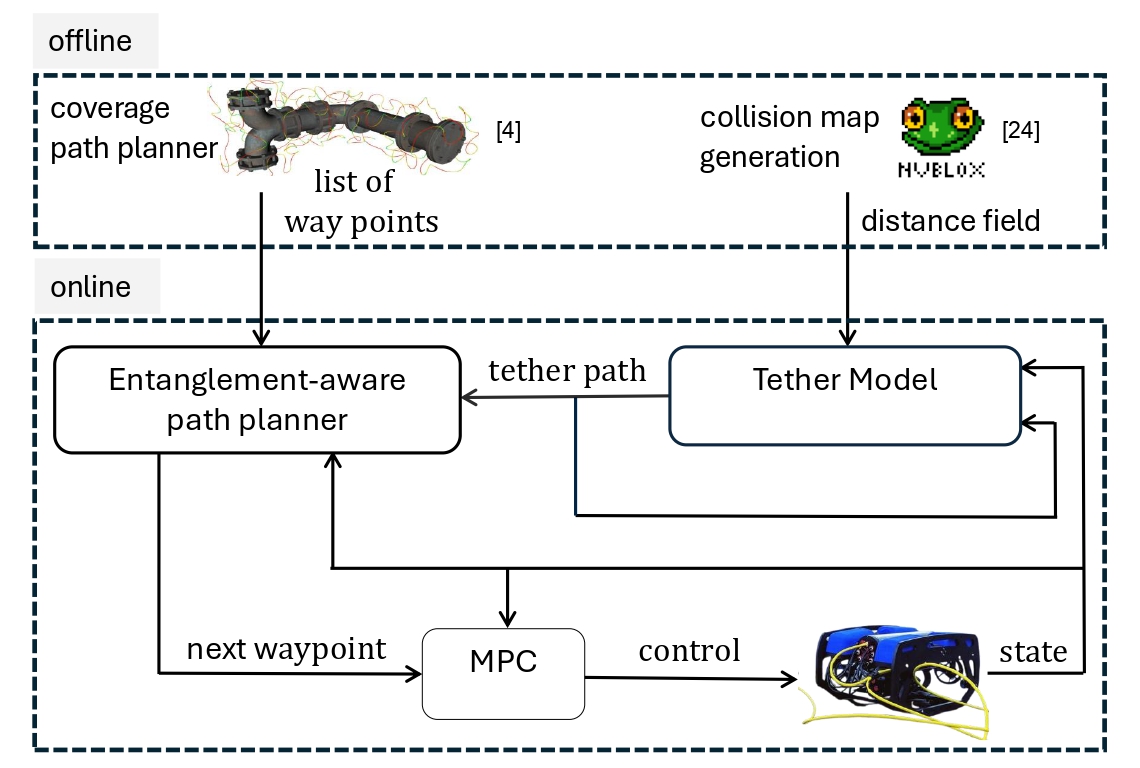
Why entanglement-aware planning matters.
ROVs need tethers for continuous power and high-bandwidth communication during subsea inspection.
Tethers wrap around structures during maneuvers, causing restricted mobility or mission failure.
Prior tether-aware planners are 2D-only, offline, or lack integrated CPP — impractical for real-time 3D coverage.
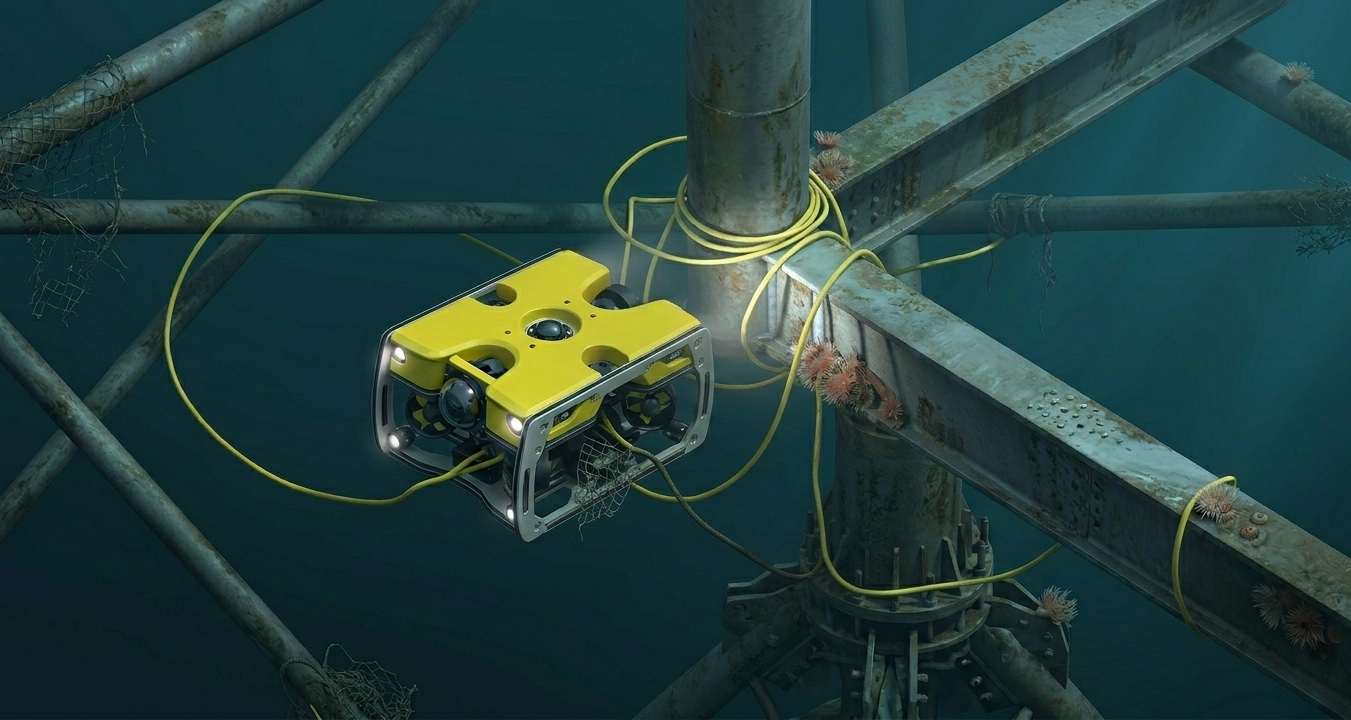
Offline coverage planning + online entanglement-aware execution.
Coverage Planning
(any off-the-shelf planner)
Tether Model
(shortcutting-based)
Entanglement-Aware
Replanner + MPC
An SDF map is built from the input point cloud via nvblox. FC-Planner then generates a full-coverage waypoint sequence — ignoring the tether entirely. Any coverage planner can be swapped in.
The tether is discretized into nodes at fixed resolution δ. A shortcutting algorithm (inspired by ropeRRT) iteratively tightens the tether around obstacles by checking line-of-sight via the SDF map, removing redundant nodes, and pulling nodes away from non-convex cavities. The resulting taut-tether length is used for entanglement detection.
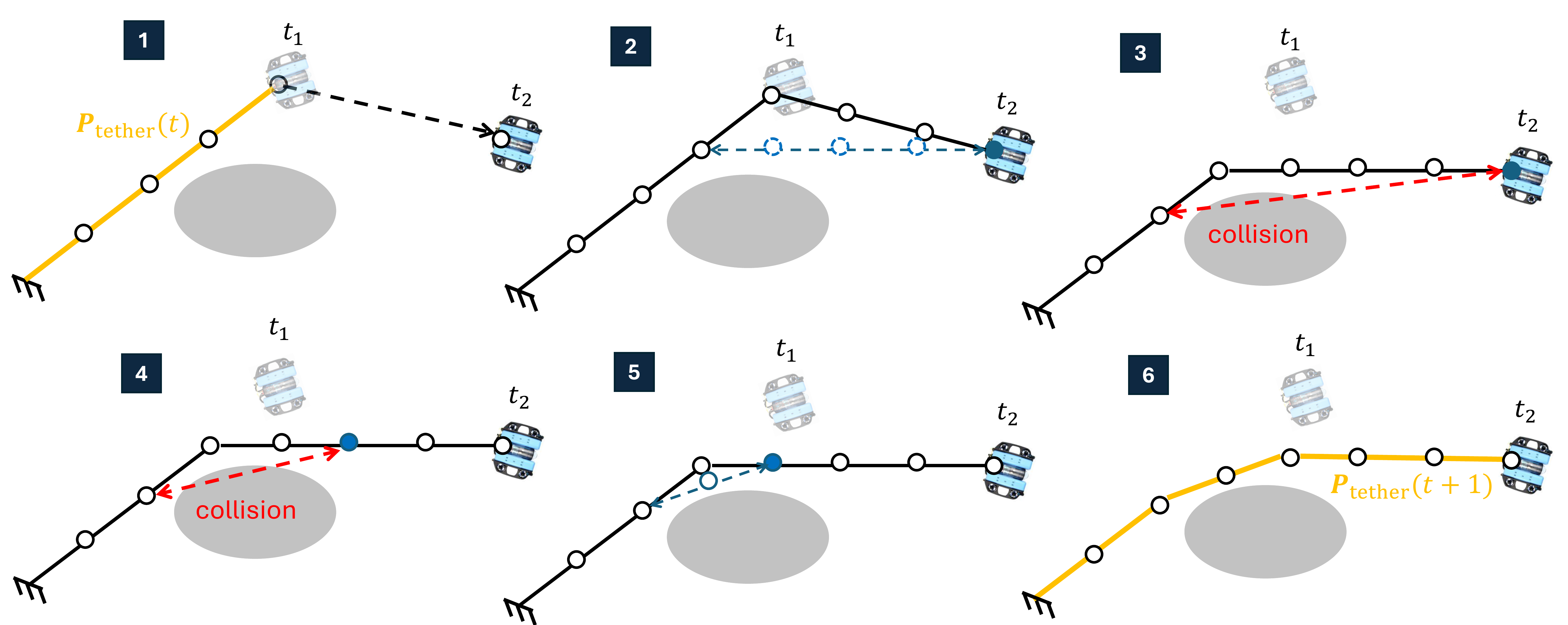
Two modes: Normal (follow waypoints while Ltether ≤ Lmax) and Recovery (triggered when Ltether > Lmax — backtrack along the tether to a pivot point, then plan a shortest path to the next waypoint). Recovery paths are smoothed via centroid offsetting and polynomial fitting, then tracked by an MPC controller.
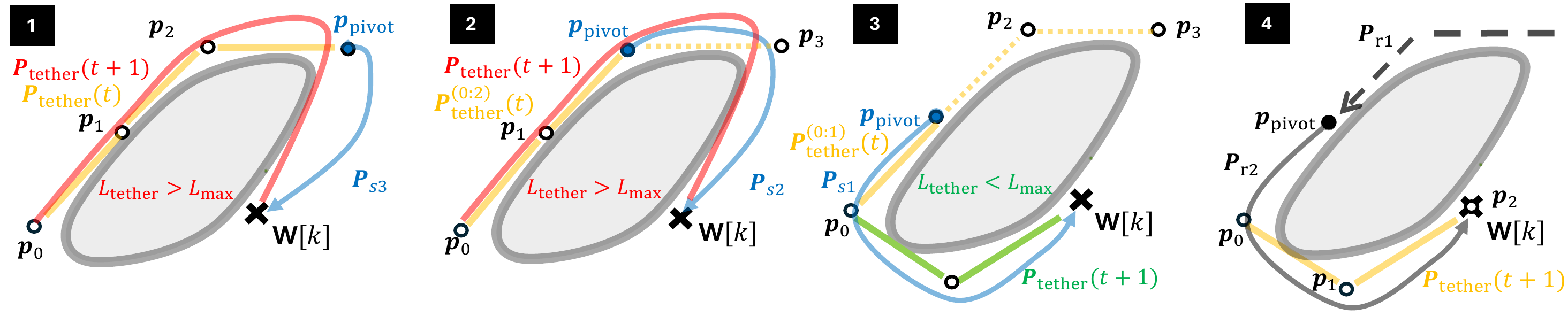
Experience the full REACT framework interactively! Click anywhere to set a goal — the ROV navigates while the tether is modeled via shortcutting, and when Lmax is exceeded, the entanglement-aware replanner computes a recovery path in real time.
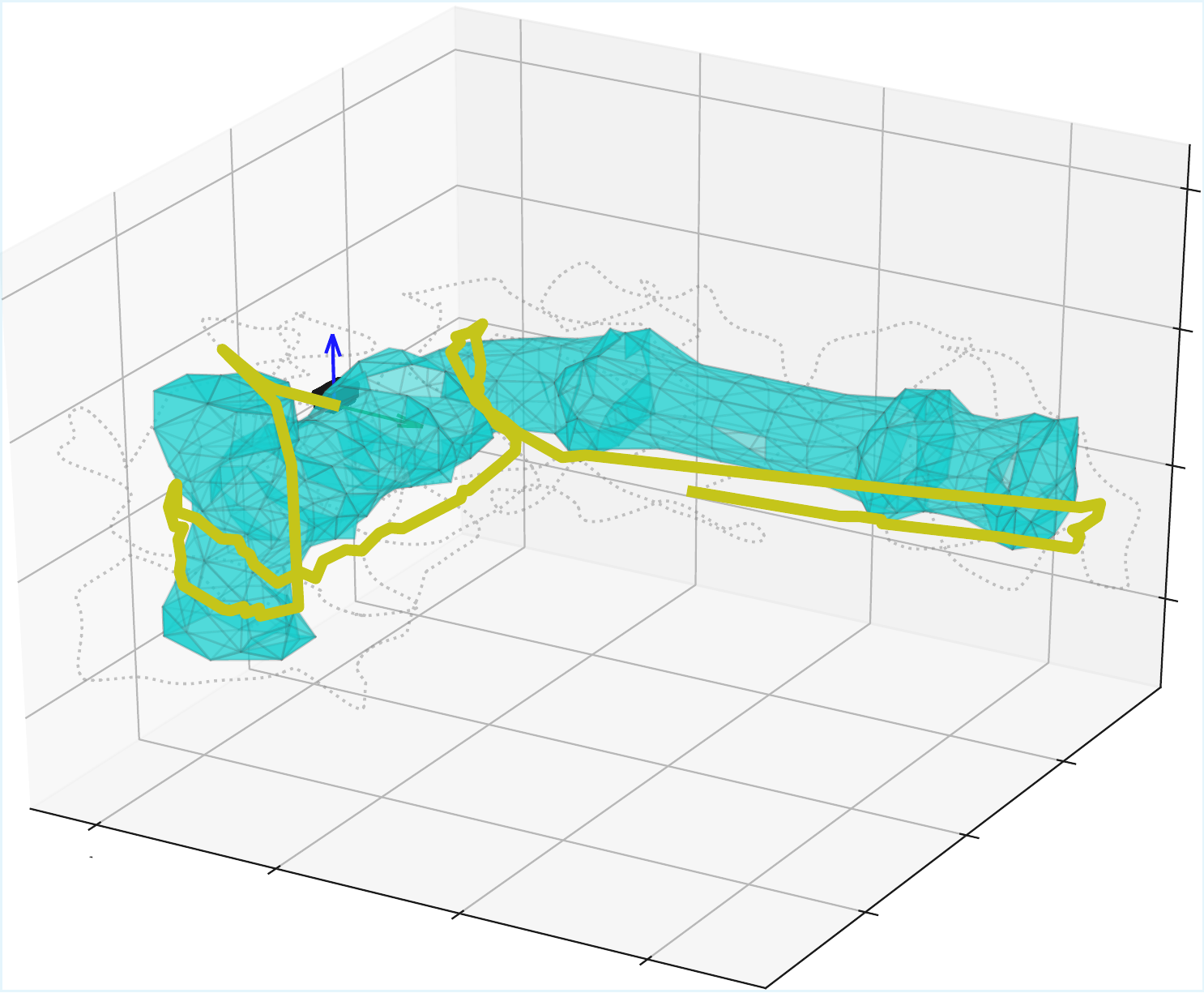
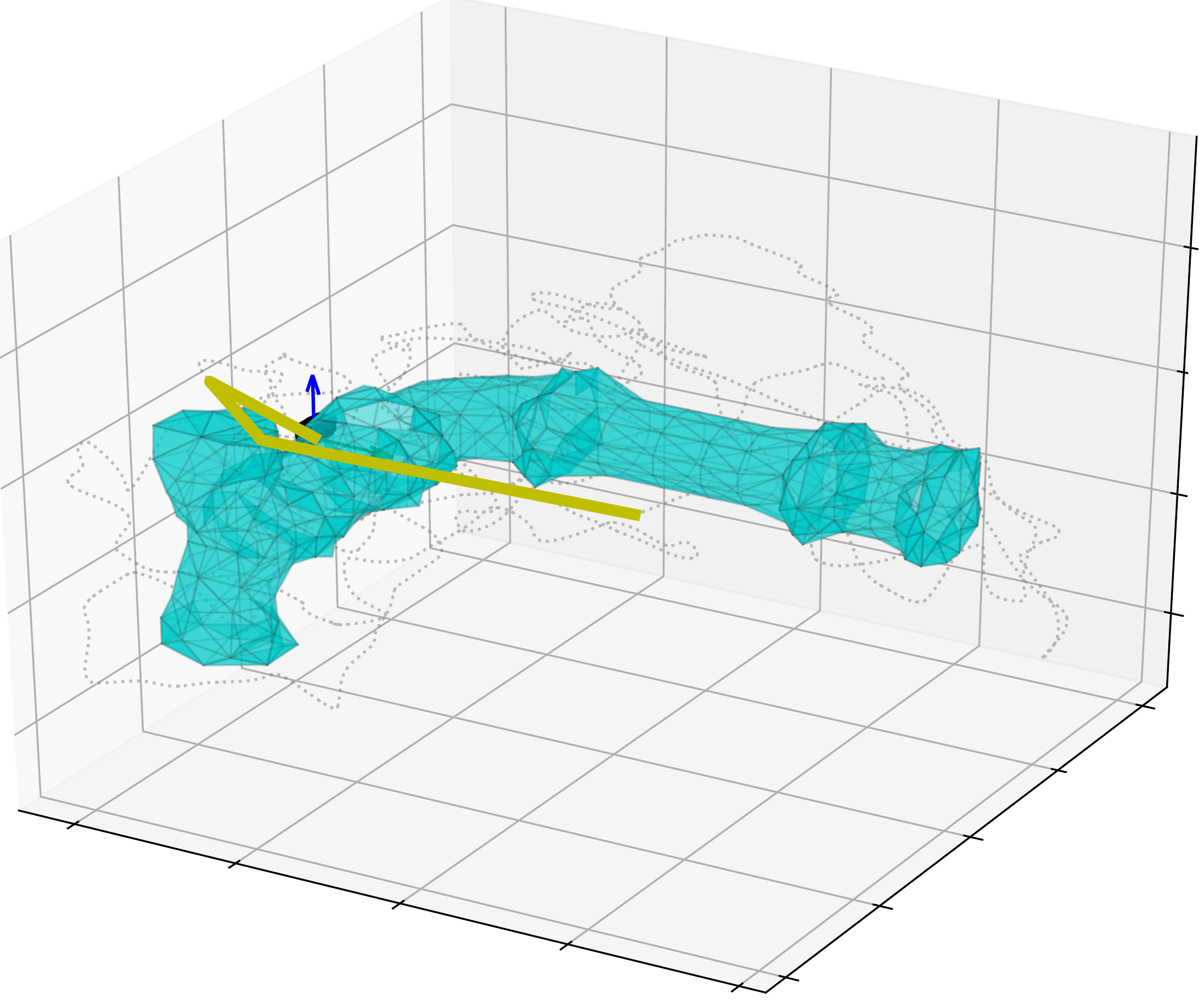
The framework is implemented in C++ with ROS integration. Evaluated on a 1/10-scale pipe structure with a BlueROV2 and Lmax = 10 m tether constraint.
| Planner | Inspection Time (s) | Recovery Time (s) | Total Time (s) | Coverage (%) |
|---|---|---|---|---|
| CPP | 429 | 426 | 855 | 99.82 |
| REACT (Ours) | 546 | 134 | 680 | 99.91 |
| Planner | Max Tether Length (m) | Duration of Exceedance (s) |
|---|---|---|
| CPP | 31.16 | 327.37 |
| REACT (Ours) | 10.52 | 10.36 |
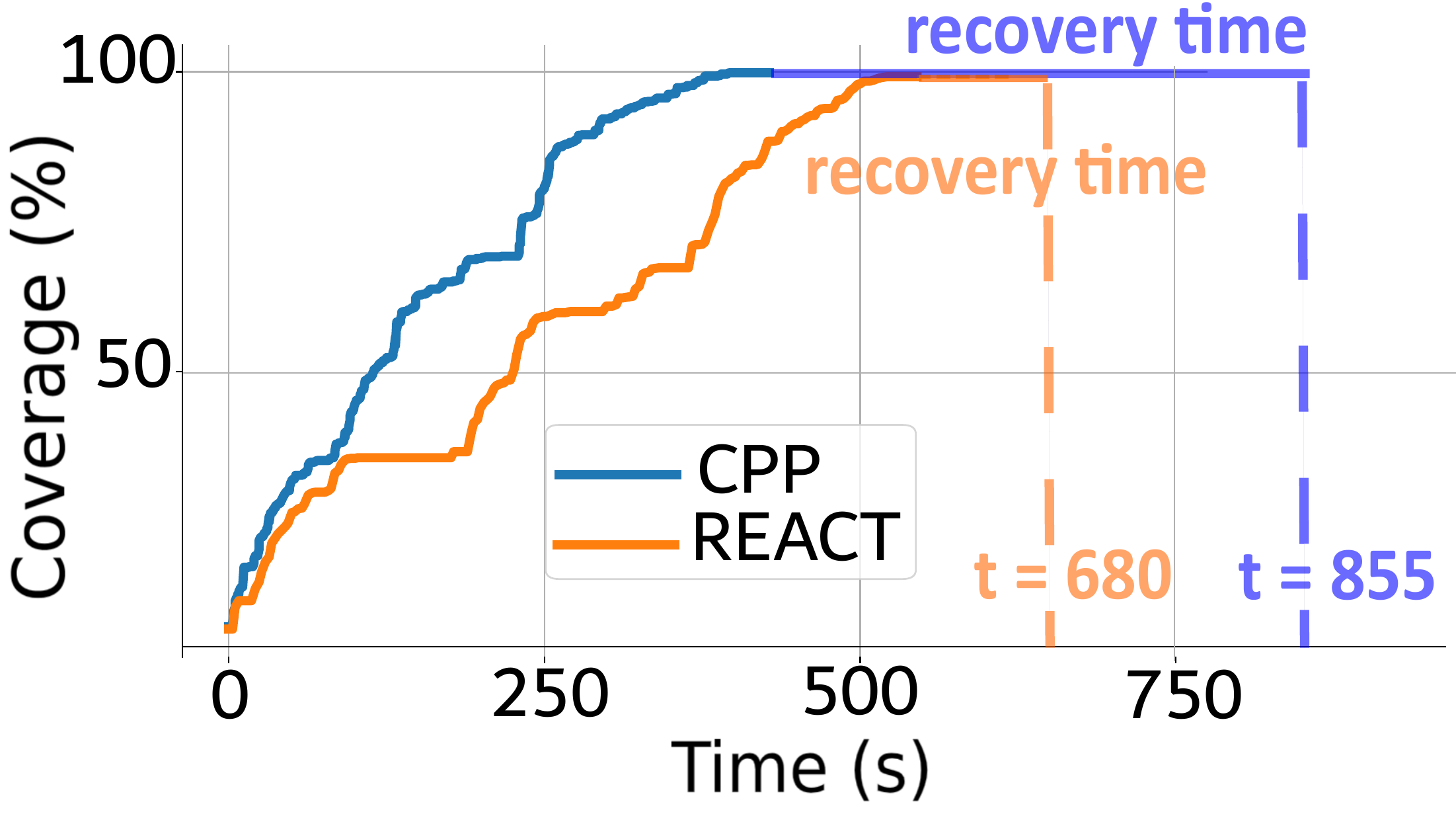
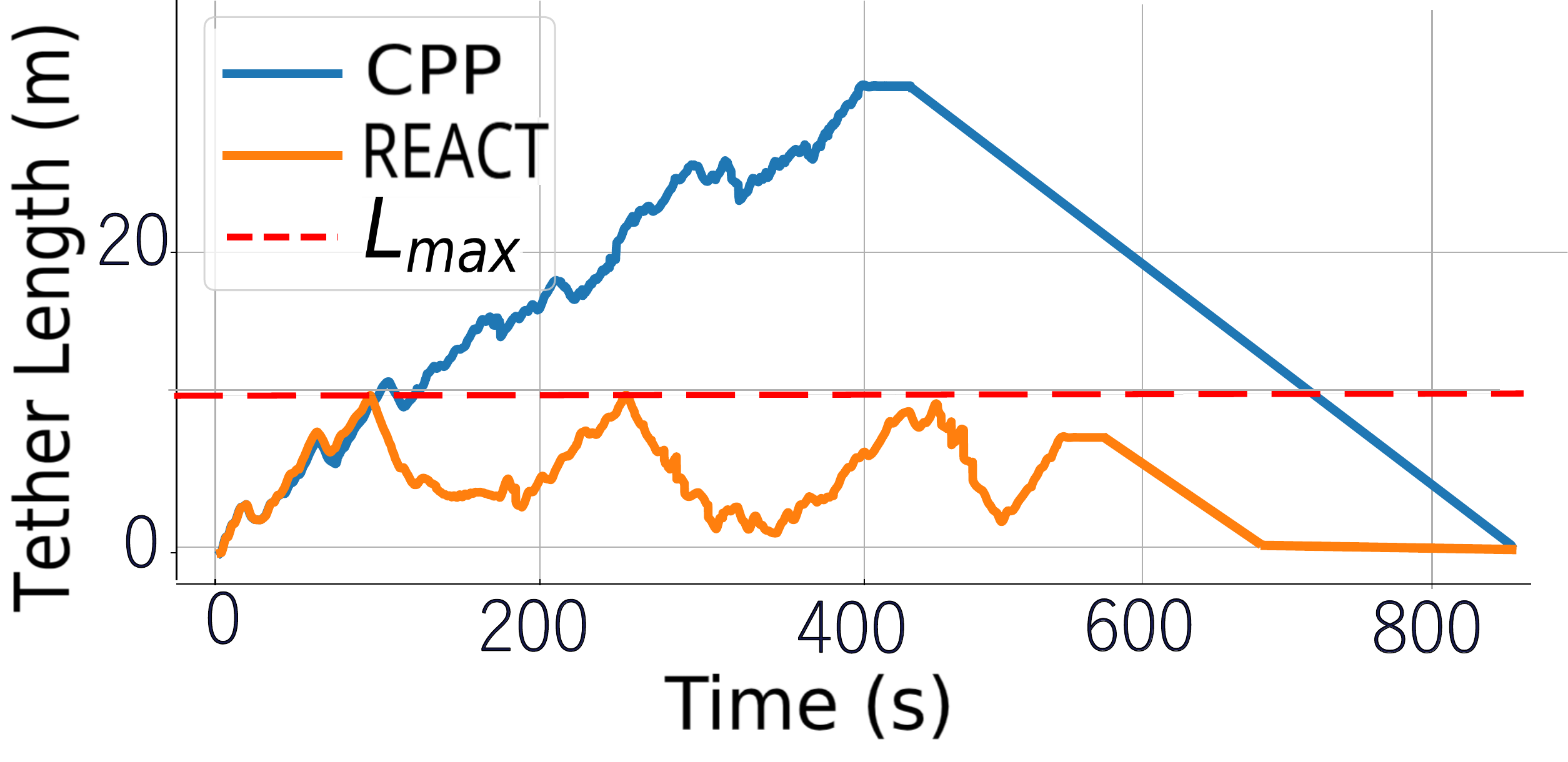
REACT achieves 25% shorter total mission time (680 s vs 855 s) with near-identical coverage, while keeping the tether within Lmax. CPP violates the constraint for 327 s, reaching 31.16 m.
Validated with a tethered BlueROV2 in DFKI's 23×19×8 m test basin equipped with a 12-camera Qualisys motion capture system, inspecting a pipe structure (∅0.7 m, length 2.5 m).
| Planner | Inspection | Coverage (%) | Computation Overhead (s) |
|---|---|---|---|
| CPP | Failed (Entangled) | 80.9 | N/A |
| REACT (Ours) | Full | 95.6 | 0.4822 |
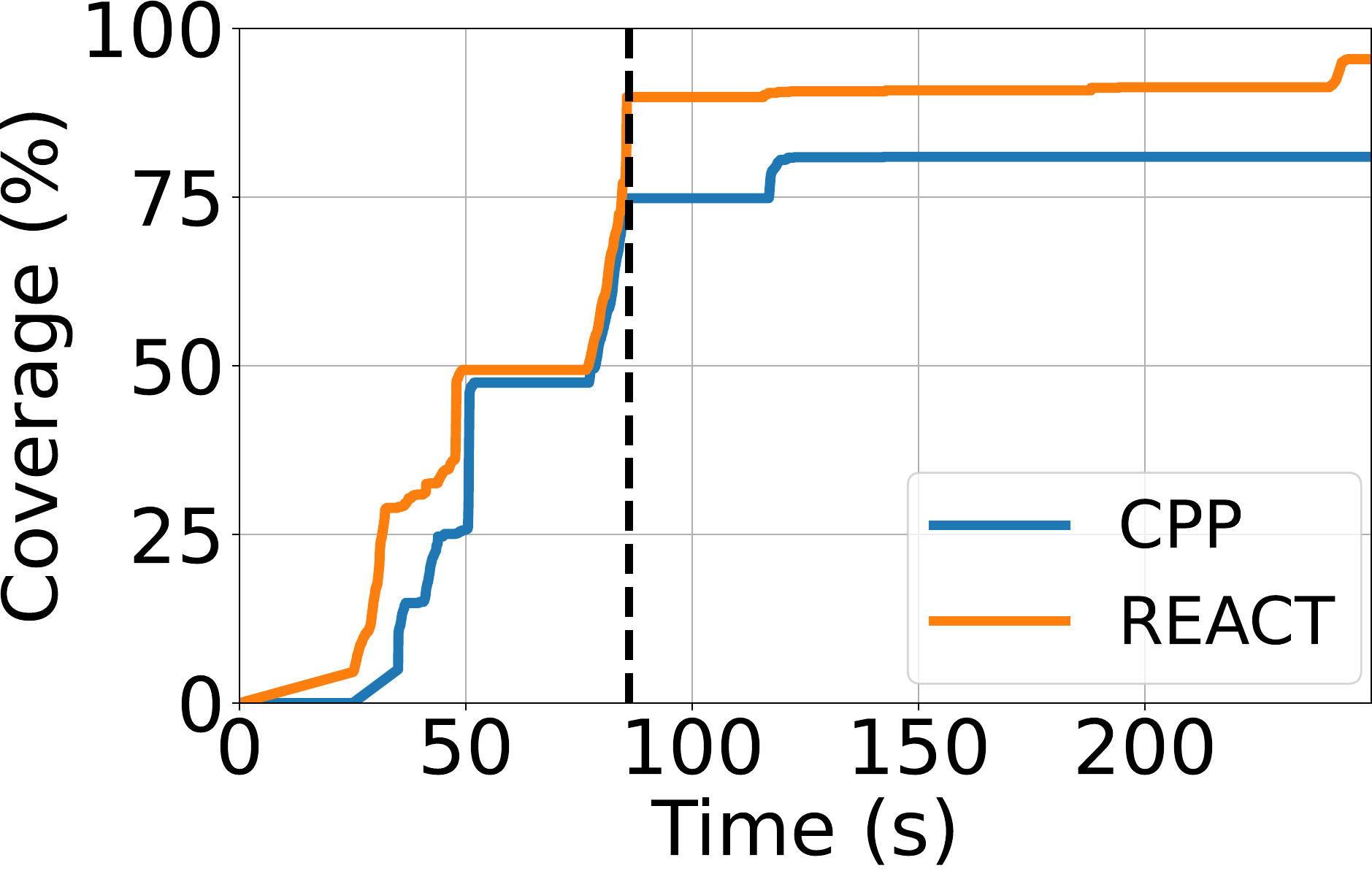
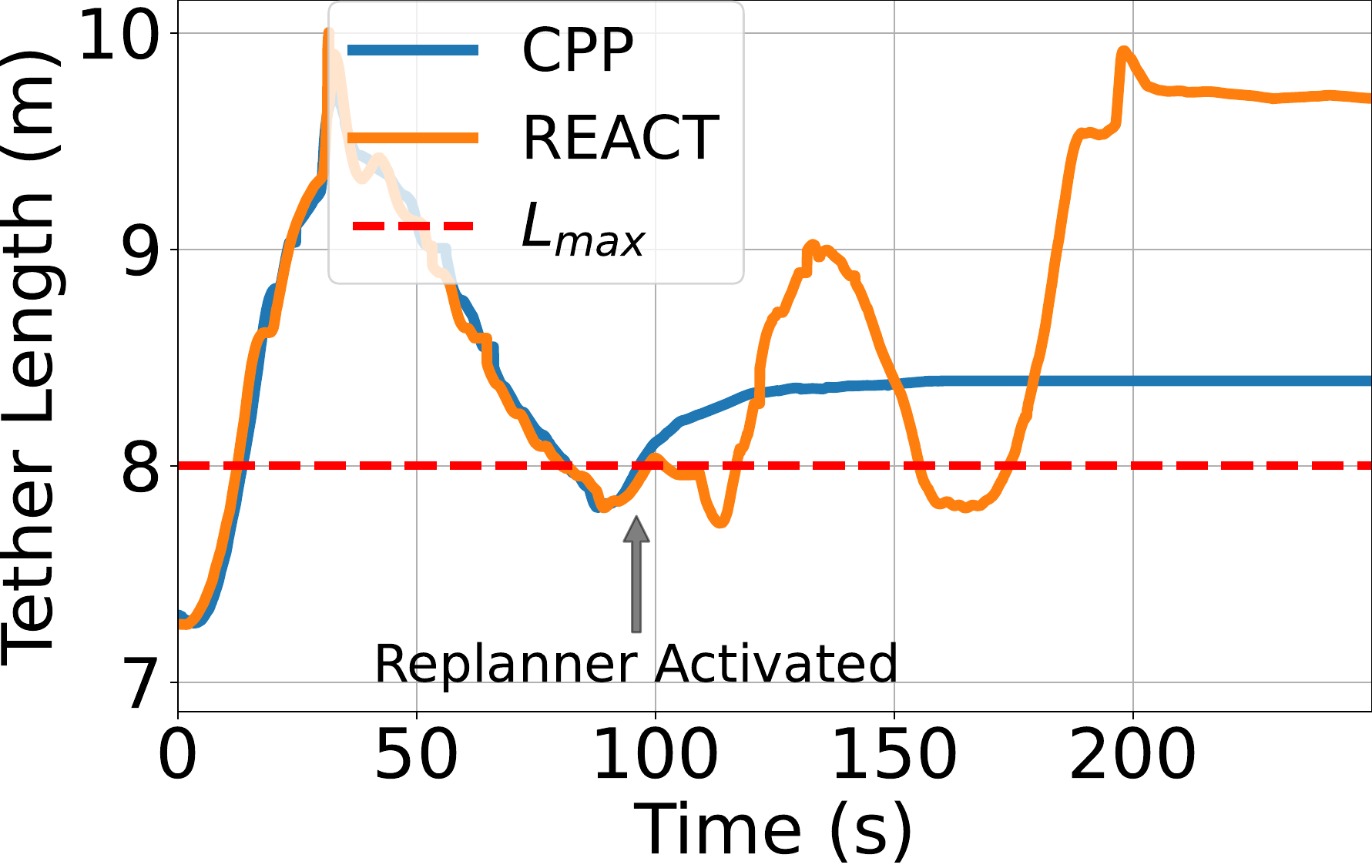
Conventional CPP gets stuck due to tether entanglement; REACT completes full inspection with zero entanglement.
Watch REACT in action: baseline CPP gets stuck, REACT completes the mission.
(1) Conventional CPP → tether entanglement → stuck (2) REACT → full inspection → zero entanglement
If you use REACT, please cite:
@article{amer2025react,
  title   = {REACT: Real-time Entanglement-Aware Coverage Path Planning
             for Tethered Underwater Vehicles},
  author  = {Amer, Abdelhakim and Mehindratta, Mohit and Brodskiy, Yury
             and Wehbe, Bilal and Kayacan, Erdal},
  journal = {arXiv preprint arXiv:2507.10204},
  year    = {2025}
}